Orvian Market › Market gardens
Market Garden Crop Planner and Succession Planting Spreadsheet
Plan every succession against your own frost dates, catch two plantings fighting over the same bed before it happens, and turn the plan into a seed order and a week-by-week harvest forecast.
$19one-time · Excel and Google Sheets
- Instant download: blank file with 34 starter crops, filled-in example file and a 2-page Start Here PDF
- Excel 2016 or newer and Google Sheets. No macros, no app, no login
- 14-day refund: reply to your Gumroad receipt
Worked example (made-up numbers)
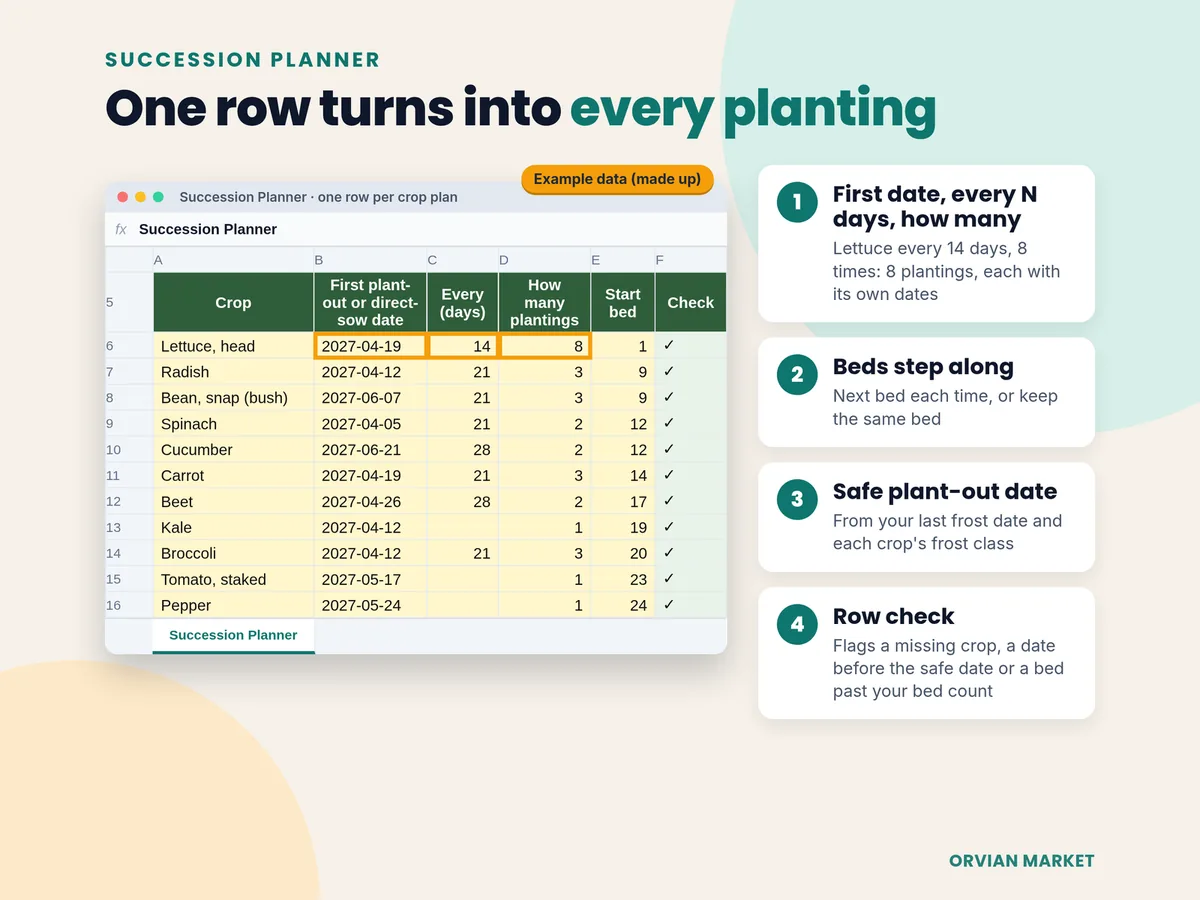
One planner row, 8 lettuce plantings
This is the example file you get: a made-up 24-bed farm with 100 ft beds, last spring frost May 10 and first fall frost Oct 5. On the Succession Planner, head lettuce gets one row: first plant-out Apr 19, every 14 days, 8 plantings, starting in bed 1. The Plantings tab writes out every one of them.
| Lettuce | Sow in tray | Plant out | Harvest | Bed |
|---|---|---|---|---|
| 1 of 8 | Mar 15 | Apr 19 | Jun 26 to Jul 9 | 1 |
| 2 of 8 | Mar 29 | May 3 | Jul 10 to Jul 23 | 2 |
| 3 of 8 | Apr 12 | May 17 | Jul 24 to Aug 6 | 3 |
| 4 of 8 | Apr 26 | May 31 | Aug 7 to Aug 20 | 4 |
| 5 of 8 | May 10 | Jun 14 | Aug 21 to Sep 3 | 5 |
| 6 of 8 | May 24 | Jun 28 | Sep 4 to Sep 17 | 6 |
| 7 of 8 | Jun 7 | Jul 12 | Sep 18 to Oct 1 | 7 |
| 8 of 8 | Jun 21 | Jul 26 | Oct 2 to Oct 15 | 8 |
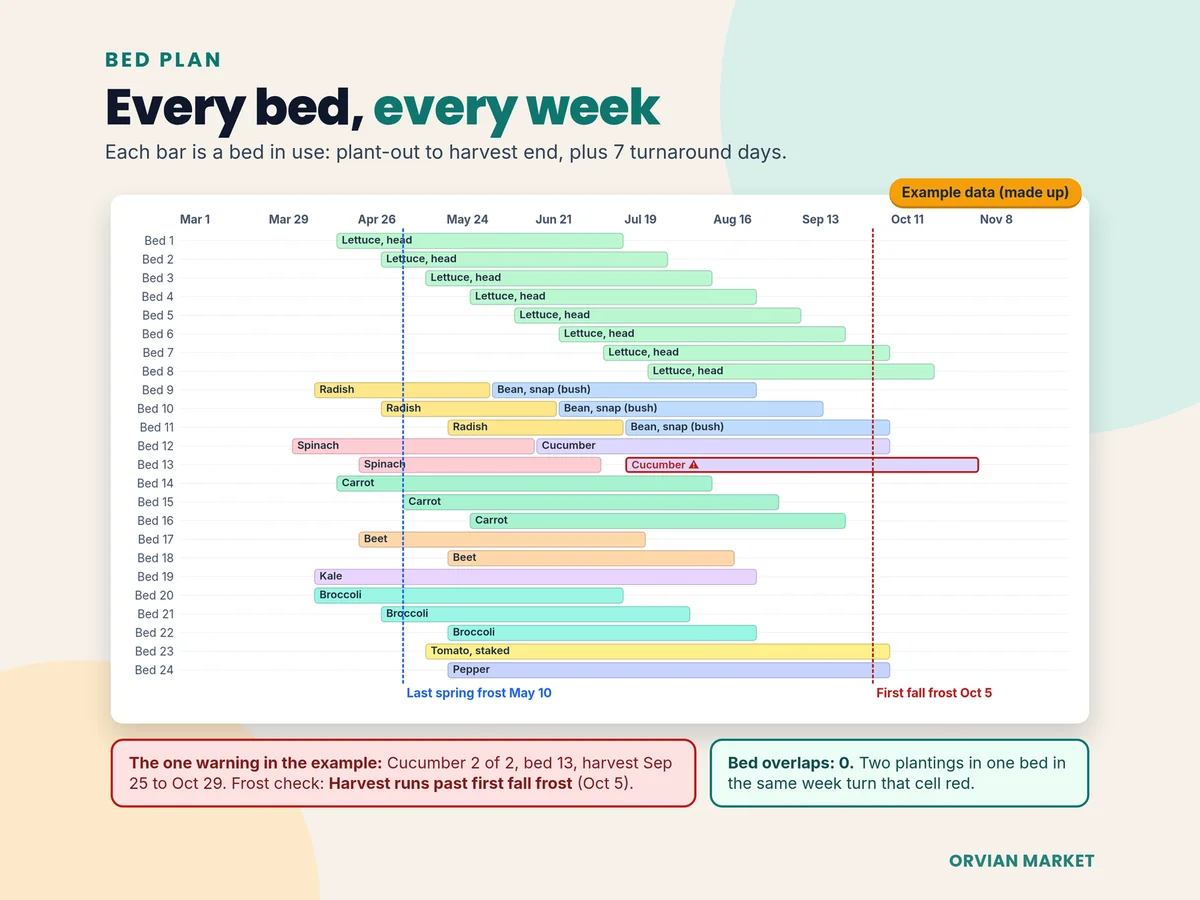
8 plantings, 8 beds, 0 overlapsEach lettuce bed is busy from plant-out until harvest ends plus 7 turnaround days, and the sheet checks every bed in every week. Across all 29 plantings on the example farm, the bed check finds 0 conflicts.
How one planting is worked out
- Sow in tray = plant-out minus 5 weeks in tray; harvest starts 68 days (days to maturity) after plant-out and runs 2 weeks
- Row feet = 1 bed × 100 ft × 4 rows = 400; plants = 400 × 12 ÷ 6 in spacing = 800
- Seeds = 800 × (1 + 10% overplant) ÷ 80% germination ÷ (1 − 10% tray loss) = 1,222
- Seed Order adds all 8: 9,778 seeds, so 10 packets of 1,000 at $4.95 = $49.50 (made-up packet price)
The one planting the sheet flagged
A late cucumber that harvests 24 days past first frost
The example farm direct-sows cucumber twice, 4 weeks apart, in beds 12 and 13. Cucumber is "very tender" in the starter library, and tender or very tender plantings whose harvest runs past your first fall frost date (Oct 5 here) get a warning. The first one finishes in time. The second doesn't, and you see it on the Plantings tab and the Bed Plan before you order seed.
| Cucumber | Sow | Harvest | Check |
|---|---|---|---|
| 1 of 2 | Jun 21 | Aug 28 to Oct 1 | ✓ OK |
| 2 of 2 | Jul 19 | Sep 25 to Oct 29 | ⚠ Past frost |
Made-up example. The file's full warning reads "Harvest runs past first fall frost". Lettuce 8 of 8 also harvests until Oct 15, past the same frost date, with no warning: lettuce is semi-hardy, and only tender and very tender crops are flagged for a late harvest. A planting is also flagged if it goes in before its safe plant-out date, or if its harvest would only start after first fall frost.
What your frost dates change
- Each crop's safe plant-out date comes from your last spring frost and its frost class: lettuce Apr 19 and cucumber May 24 on the example farm
- Type different frost dates and the safe dates and every frost warning update right away
- Your plantings don't move on their own: the first date per crop is the one you type. Change it and all of that crop's later successions move with it
The whole season (made-up numbers)
From 11 planner rows to a seed bill and a harvest forecast
Farm Settings sums up the example season. The harvest value is the file's estimate from starter yields and the example's made-up prices per unit, not a yield or income forecast for your farm: weather, variety and soil change real yields.
| Example season summary | Value |
|---|---|
| Beds × bed length | 24 × 100 ft |
| Plantings (11 crops) | 29 |
| Planner rows that need a fix | 0 |
| Bed warnings | 0 |
| Frost warnings | 1 |
| Seed cost (packets to buy) | $518.35 |
| Expected harvest value at example prices | $22,345 |
| Value per CSA share (30 shares) | $744.83 |
| Busiest week (week of Aug 2) | $1,858.33 |
What's inside
9 tabs, from frost dates to a weekly task list
Type in the yellow cells; everything else calculates. A settings check and row checks tell you what's missing, and red cells mark frost risks and bed overlaps.
- Start HereSetup steps, where the starter values come from and the math in plain words
- Farm SettingsFrost dates, bed length, up to 40 beds, overplant and tray-loss allowances, turnaround days, CSA shares and a season summary
- Crop Library60 crop rows, 34 filled with starter crops: days to maturity, spacing, rows per bed, seed rate, weeks in tray, germination, frost class, yield
- Succession Planner40 crop plans: first date, days between plantings, how many and the start bed
- PlantingsUp to 300 plantings with tray, plant-out and harvest dates, row feet, plants, seed and warnings
- Bed Plan40 beds by 40 weeks; a red cell means two plantings want the same bed that week
- Seed OrderSeed needed per crop, whole packets to buy and seed cost
- Harvest and SalesExpected harvest per crop per week, value per week and per CSA share
- CalendarEvery sow, plant-out and harvest task in date order, with beds and amounts
Is it a fit?
Made for
- Market gardeners and small farms, about a quarter acre to a few acres, growing in beds
- CSA growers who want a harvest-by-week view and a value per share
- Anyone who plans successions and orders seed over the winter
- Growers who'd rather own a spreadsheet than pay for a farm app every month
Not made for
- Field-scale farms planning by the acre with tractors, not beds
- Greenhouse climate control, irrigation or fertility planning
- Weather forecasts or guaranteed dates and yields: starter values are averages you check against your seed packets
- Food safety, certification or record-keeping rules: the file makes no such statements
How the math is checked
Every formula tested against a separate model
Before release, a test script rebuilt every result outside the spreadsheet: 4,242 comparisons on the example file and 2,896 on the blank one, plus 24 edited and random test plans with 122,509 comparisons against an independent model, 0 failures. Negative tests made sure every warning fires: bed conflicts, beds past your bed count, plantings before the safe date or past first fall frost, and planner and library errors.
Where the starter values come from
University of Missouri Extension G6201 and the Territorial Seed Company planting chart (days to maturity, spacing, seed rate, yield), Purdue Extension HO-186 (frost classes), Rutgers NJAES FS787 (weeks in tray) and the federal minimum germination standards in 7 CFR 201.31 (your packet often tests higher). Rows per bed and harvest weeks are our own estimates for a 30-inch bed. Check them all against your seed packets and change any that don't fit your farm.
How it's made
Formulas, layout and copy were created by Orvian Market with AI-assisted drafting, and every formula is tested as described here. The farm, dates, prices and packet sizes in the example file are made up. This is a planning tool, not agronomic, business or professional advice.
Microsoft Excel and Google Sheets are trademarks of their owners; Orvian Market isn't affiliated with them.
Questions
Does it work in Google Sheets?
Yes. It's a regular .xlsx file with standard formulas and no macros. Open it in Excel 2016 or newer, or in Google Sheets use File → Import → Upload.
My frost dates are different. What changes?
Type your two frost dates on Farm Settings. Each crop's safe plant-out date and the frost warnings update right away, so you can see which first dates to move. Planting dates don't move by themselves: change a crop's first date on the Succession Planner and all its later successions move with it.
Can I add crops that aren't in the starter list?
Yes. There are 26 empty Crop Library rows; fill in the numbers from your seed packet or catalog and the crop shows up in the Succession Planner.
Are the starter numbers right for my farm?
They're averages from extension guides and a seed company chart, for other regions and varieties, and rows per bed and harvest weeks are our own estimates for a 30-inch bed. Treat them as a starting point and change any number that doesn't match your seed packets or your own records.
How big a farm does it handle?
Up to 40 beds, 40 crop plans and 300 plantings over a 40-week window. Every bed is treated as the same length, which you set on Farm Settings.
How do I get the files, and what if it's not right for me?
Checkout is on Gumroad and the download link arrives right away by email. If a file won't open or isn't what you expected, reply to your Gumroad receipt within 14 days and we'll fix it or refund you.
Plan next season from your own frost dates
$19 once. Blank file, filled-in example and Start Here PDF, delivered instantly.