Orvian Market › Food trucks
Food Truck Menu Cost Calculator
Cost every plate from your own ingredient prices, set menu prices at your target food cost %, and see what an event will make and how many orders it takes to break even, before you book it.
$19one-time · Excel and Google Sheets
- Instant download: blank file, filled-in example file and a 2-page Start Here PDF
- Excel 2016 or newer and Google Sheets. No macros, no app, no login
- 14-day refund: reply to your Gumroad receipt
Worked example (made-up numbers)
One chicken taco plate, every ingredient on its own line
This is the example file you get: a made-up taco truck with a 30% target food cost. Each line converts your pack price and usable yield into the cost of what goes on the plate, including batch recipes like the chicken tinga and salsa.
| Per serving | Qty | Cost |
|---|---|---|
| Corn tortillas 6 in | 6 each | $0.49 |
| Chicken tinga (batch recipe) | 6 oz | $1.35 |
| Salsa roja (batch recipe) | 2 fl oz | $0.15 |
| Pickled red onions (batch recipe) | 2 tbsp | $0.06 |
| Cilantro | 0.1 bunch | $0.06 |
| Lime crema (batch recipe) | 1 fl oz | $0.13 |
| Limes | 0.5 each | $0.07 |
| Plate food cost | $2.31 | |
| Menu price | $8.00 | |
| Food cost % | 28.9% | |
| Packaging | $0.35 | |
| Gross profit per plate | $5.34 |
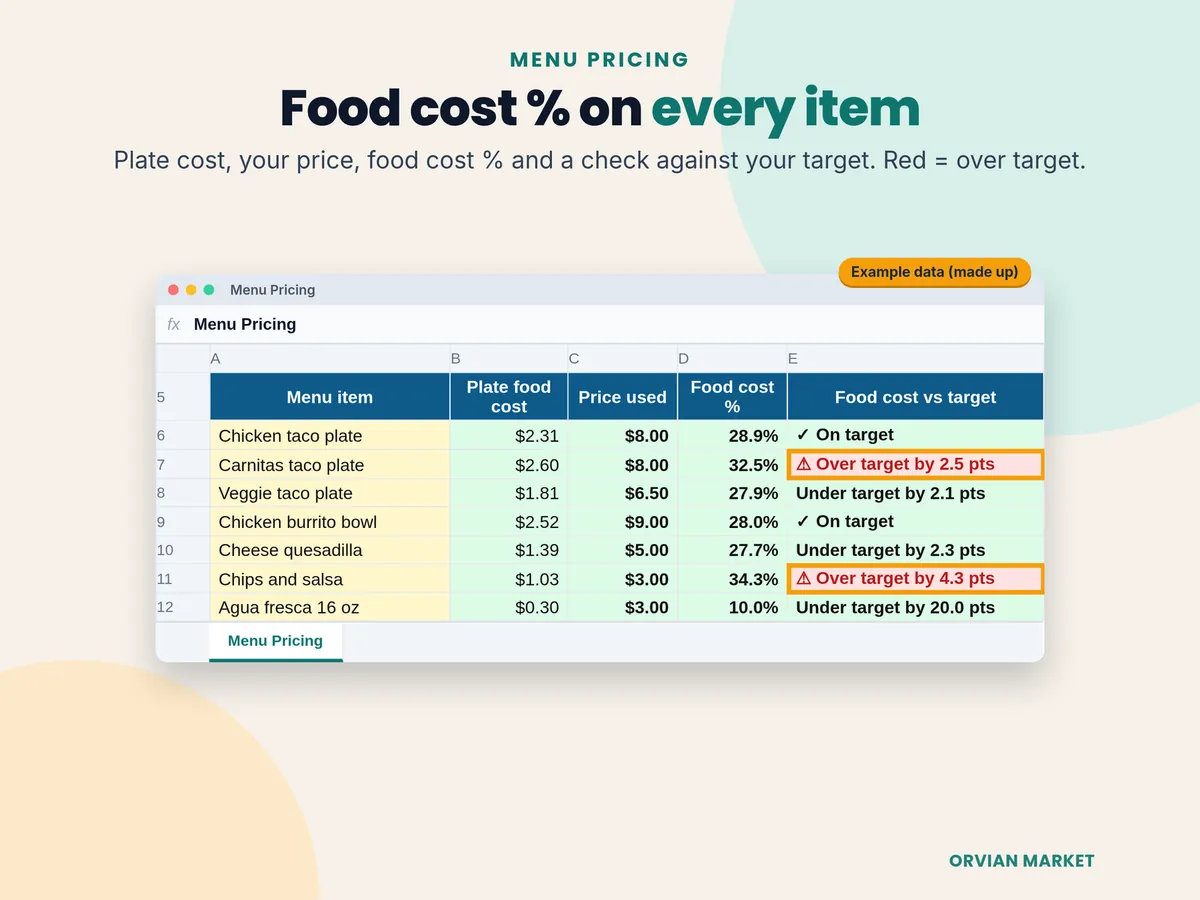
28.9% food cost, on targetThe chicken plate sits inside the 28% to 32% band. On the same menu, the carnitas plate runs 32.5% at the same $8 and chips and salsa 34.3%, so the sheet flags both and suggests $9 and $3.50.
How the numbers are worked out
- Cost per usable unit = pack price ÷ (pack size × usable yield %), so trim and cooking loss are counted
- Units convert with exact US definitions (1 lb = 453.59237 g, 1 cup = 8 fl oz), and grams per cup handles buy-by-weight, measure-by-volume
- Food cost % = plate food cost ÷ menu price (packaging, labor and card fees are left out, and the file says so)
- Suggested price = plate food cost ÷ target food cost %, rounded up to your step
The event that barely paid
A $959 brewery night that kept $45.15
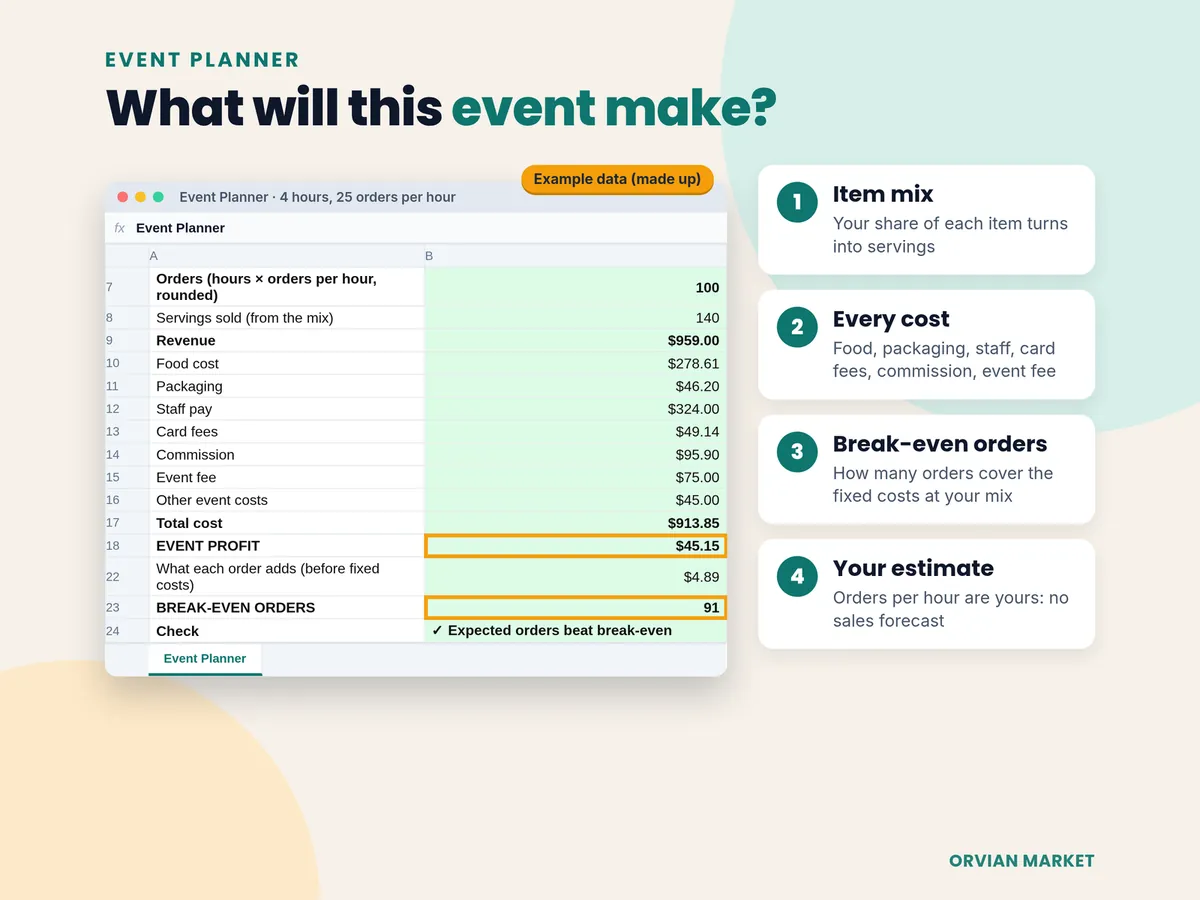
From the example Event Planner (made-up event). Four hours open, 25 orders an hour, a $75 booth fee, 10% commission to the venue and three people paid for six hours each. Sales look good. Then every cost comes off.
| Brewery night (example) | Amount |
|---|---|
| Revenue (100 orders, 140 items) | $959.00 |
| Food cost | $278.61 |
| Packaging | $46.20 |
| Staff pay | $324.00 |
| Card fees | $49.14 |
| Commission (10%) | $95.90 |
| Event fee | $75.00 |
| Other (fuel, generator, ice) | $45.00 |
| Event profit | $45.15 |
| Break-even orders | 91 of 100 |
Made-up example. That's 4.7% of sales, about $11.29 per hour open. On the Price What-If tab, chicken going from $98 to $122 a case moves the chicken plate from $2.31 to $2.64, the event profit to $28.27 and break-even to 95 orders.
What's inside
10 tabs, from ingredient prices to a printable cost sheet
Type in the yellow cells; everything else calculates. A settings check on Start Here tells you what's still missing, and row checks flag a wrong name or a unit that can't convert.
- Start HereSetup steps, a settings check and what each number means
- SettingsTarget food cost %, price rounding, packaging, staff pay, card fees and a unit table
- Ingredients150 rows with pack size, pack price and usable yield %
- Sub-Recipes30 batch recipes (300 lines) with batch cost and cost per unit
- Menu Items500 recipe lines, one serving per menu item
- Menu Pricing40 items with plate cost, suggested price, food cost % and a target check
- Event PlannerItem mix, fees, commission, staff, profit and break-even orders
- Purchase and PrepWhole packs to buy and batches to make for the event
- Price What-IfWhat a supplier price change does to every plate and the event
- Printable Cost SheetOne menu item, its lines and totals on one page
Is it a fit?
Made for
- Food truck, trailer and cart owners pricing a menu
- Pop-up and market vendors deciding which events are worth booking
- Small caterers (1 to 5 staff) costing recipes and batches
- Anyone whose supplier prices keep moving and wants every plate re-costed at once
Not made for
- Restaurants that need inventory counts, POS sync or nutrition labels
- Food safety, health permits or local rules: the file makes no such statements
- Sales forecasting: orders per hour are your own estimate
- Typical prices: it has no supplier data; you type your own
How the math is checked
Every formula tested against a separate model
Before release, a test script rebuilt every result outside the spreadsheet: 72 test scenarios with 689,746 comparisons against an independent model, 0 failures, 35 exact unit-conversion cases, and a full recalculation in a second spreadsheet program that matched. It also broke formulas on purpose to make sure the checks catch it.
How it's made
Formulas, layout and copy were created by Orvian Market with AI-assisted drafting, and every formula is tested as described here. Prices, yields and the event in the files are examples, not typical or average figures. This is a costing and planning tool, not accounting, tax, legal or professional advice.
Microsoft Excel and Google Sheets are trademarks of their owners; Orvian Market isn't affiliated with them.
Questions
Does it work in Google Sheets?
Yes. It's a regular .xlsx file with standard formulas and no macros. Open it in Excel 2016 or newer, or in Google Sheets use File → Import → Upload.
I buy by the pound but measure by the cup. Does that work?
Yes. Type grams per cup (or grams per each) on the ingredient's row and the recipe line converts.
What does food cost % include?
Only the ingredients and batch recipes in one serving, after yield. Packaging, labor, card fees and sales tax are left out of food cost % and counted separately in the Event Planner, because definitions differ and the file states which one it uses.
Can a batch recipe go inside another batch recipe?
No, one level only: batch recipes are built from ingredients, and menu items from ingredients and batch recipes. The row check tells you if you try.
Does it know what my ingredients cost?
No. Prices differ by supplier and week, so you type your own. Every number in the example file is made up.
How do I get the files, and what if it's not right for me?
Checkout is on Gumroad and the download link arrives right away by email. If a file won't open or isn't what you expected, reply to your Gumroad receipt within 14 days and we'll fix it or refund you.
Price your next event from your own numbers
$19 once. Blank file, filled-in example and Start Here PDF, delivered instantly.